
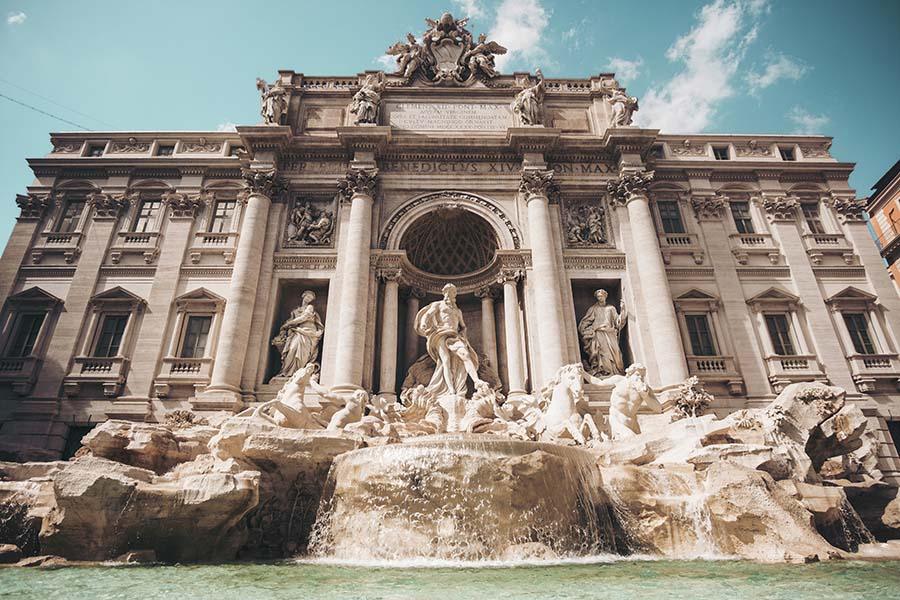
The Trevi Fountain in Rome (Fontana di Trevi) isn’t just a magnificent work of art; it’s an enduring symbol of the city’s history, a masterpiece of Baroque architecture, and a focal point for millions of visitors each year. Its grandeur, history, and unique traditions make it an unmissable stop on any Roman itinerary.
History of the Trevi fountain: when it was built and what it symbolizes
The history of the Trevi Fountain is deeply rooted in ancient Rome. It marks the terminal point of the Aqua Virgo (Acqua Vergine), one of the city’s oldest and most well-preserved aqueducts, completed in 19 BC. Legend holds that a young Roman girl (a “virgo”) led thirsty Roman soldiers to the source of the pristine water that still feeds the fountain today.
The current spectacular fountain, however, was commissioned in the 17th century. The final design, chosen after a competition, was by Nicola Salvi. Construction began in 1732 and, due to delays, was completed by Giuseppe Pannini in 1762, after Salvi’s death. This answers the question: when was the Trevi Fountain built? It took 30 years to create the masterpiece we see today!
The fountain’s central theme is the taming of the waters. The design is a blend of natural elements and classical mythology, with a triumphant chariot of the ocean god, Oceanus, emerging from the central arch.
The statues of the Trevi fountain: what do they represent?
The monumental fountain’s composition is a theatrical spectacle of stone. At its heart, beneath a magnificent triumphal arch, stands Oceanus (often mistaken for Neptune), the powerful god of the sea, riding a shell-shaped chariot pulled by two horses, the Tritons.
The two horses symbolize the different states of the sea: one is restless, representing rough waters, while the other is calm, symbolizing tranquility.
Flanking Oceanus are allegorical statues in the niches:
- On the left is the statue of Abundance (or Plenty), holding a tilted urn.
- On the right is the statue of Salubrity (or Health), crowned with a wreath of laurel.
Above the niches are relief panels depicting the history of the Aqua Virgo aqueduct, including the young girl leading the soldiers to the water source.
Where is the Trevi fountain located?
The Trevi Fountain is in the Trevi district (Rione Trevi), nestled amongst the charming, narrow streets of central Rome. It’s famous for taking up the entire width of the Piazza di Trevi, giving it a dramatic, imposing presence.
It is easily reachable from other major landmarks:
- The Pantheon is about a 10-minute walk away.
- The Spanish Steps are about a 10-minute walk away.
If you are arriving via public transport, the fountain is about a 20-minute walk from the main transport hub: Roma Termini to Trevi Fountain. Alternatively, the closest Metro stop is Barberini (Line A), which is about a 5 to 10-minute walk.
Interesting facts about the Trevi Fountain you probably didn’t know
The fountain is probably most famous worldwide for the tradition of coin throwing. Legend dictates that if you throw a coin into the fountain over your shoulder (with your back to the water):
- One coin ensures your return to Rome.
- Two coins mean you will fall in love with a Roman.
- Three coins guarantee a wedding or divorce!
A staggering amount of money is thrown into the fountain—roughly €3,000 every single day. The city of Rome collects these funds (the coin throwing practice is legal) and dedicates the money to a Catholic charity, Caritas, to help finance supermarkets and social programs for the city’s poor.
Another secret: The large vase on the right side, known as the “Ace of Cups” (Asso di Coppe), was allegedly placed there by Salvi to obscure the view of a troublesome local barber who was constantly criticizing the construction.
To get the best experience, visit the fountain very early in the morning (before 8 AM) or late at night when the crowds thin out and the magnificent lighting highlights the marble and water for a truly magical view.