
The city of Rome is a living museum, a continuous stratification of history and culture. Among its most striking monuments are the towering obelisks, slender needles of stone that pierce the sky. But how many are there, and what is their history?
Rome has the distinction of having more Egyptian and ancient obelisks than any other city in the world. There are 13 major ancient obelisks that stand in the city’s squares, a testament to the city’s imperial reach and subsequent fascination with ancient Egypt.
The Egyptian Obelisks in Rome: History and Origins of These Monuments
The story of the egyptian obelisks in rome is a fascinating journey through time. Originally quarried and carved in Egypt centuries before Christ, most were brought to Rome by various emperors after the Roman conquest of Egypt in 30 BC. These monuments were transported across the Mediterranean and erected in places of importance, like the Circus Maximus, to symbolize Rome’s power and its connection to a sophisticated ancient culture.
After the fall of the Roman Empire, many of the obelisks toppled or lay buried and forgotten for centuries. It wasn’t until the Renaissance, and particularly the reign of Pope Sixtus V in the late 16th century, that a massive project was undertaken to rediscover, restore, and re-erect these ancient relics, often in front of major churches or in the center of newly designed squares.
Curiosities About Rome’s Obelisks: Myths, Relocations, and Restorations
The process of re-erecting these colossal monuments was an engineering feat in itself. The massive undertaking of moving the obelisk now standing in St. Peter’s Square (the Vatican Obelisk) from its original position next to the old basilica to its current spot in 1586 is one of the most famous tales. Legend says that during the strenuous operation, when the ropes holding the stone began to fray, a sailor famously broke the mandated silence and shouted, “Water on the ropes!” The advice saved the day, and the obelisk was successfully raised.
Almost all the obelisks were originally dedicated to Egyptian gods, but upon their relocation in Rome, they were “Christianized” with crosses or papal symbols at their apex, integrating them into the city’s new religious landscape.
Piazza della Rotonda Obelisk and Macuteo Obelisk: Two Gems in the Heart of Rome
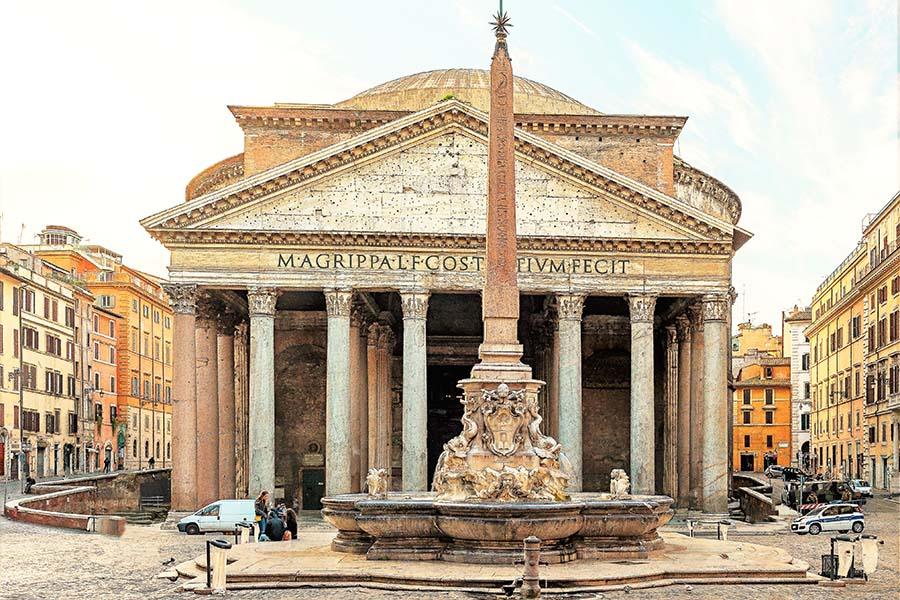
While 13 major obelisks dot the city, a couple of smaller, yet equally important, ones can be found near the Pantheon. The famous Obelisco della Rotonda (also known as the Piazza della Rotonda Obelisk) stands proudly atop the fountain in front of the Pantheon. Dating from the reign of Ramesses II, it was originally used in the nearby Temple of Isis and was placed here in 1711.
Not far away, in Piazza di San Macuto, stands the Obelisco Macuteo (the Macuteo Obelisk). Like its neighbor, it was part of the Iseum (a temple dedicated to the goddess Isis), a testament to the powerful Egyptian cult that flourished in Rome. It was later moved to the Piazza di Montecitorio.
Where to Find Rome’s Obelisks: A Map of the Most Important Ones
For anyone looking to complete a full tour of the obelisks in Rome, here are some of the most prominent ones and their locations:
- Lateran Obelisk: Piazza di San Giovanni in Laterano (The largest standing ancient Egyptian obelisk in the world).
- Flaminian Obelisk: Piazza del Popolo (One of the two obelisk rome brought by Augustus).
- Solare Obelisk (or Obelisk of Montecitorio): Piazza di Montecitorio.
- Vatican Obelisk: Piazza San Pietro (The only major obelisk not to have hieroglyphs, it stood in the Circus of Caligula and Nero).
- Agonalis Obelisk: Piazza Navona (Topped by the dove of Pope Innocent X, standing on Bernini’s Fountain of Four Rivers).
- Minerveo Obelisk: Piazza della Minerva (The smallest of the Egyptian ones, famously placed atop a marble elephant designed by Bernini).
These ancient monuments continue to tell a powerful story of empires, religion, and enduring artistic ambition.